Integrations6 min
Critical integrations deserve a safe place
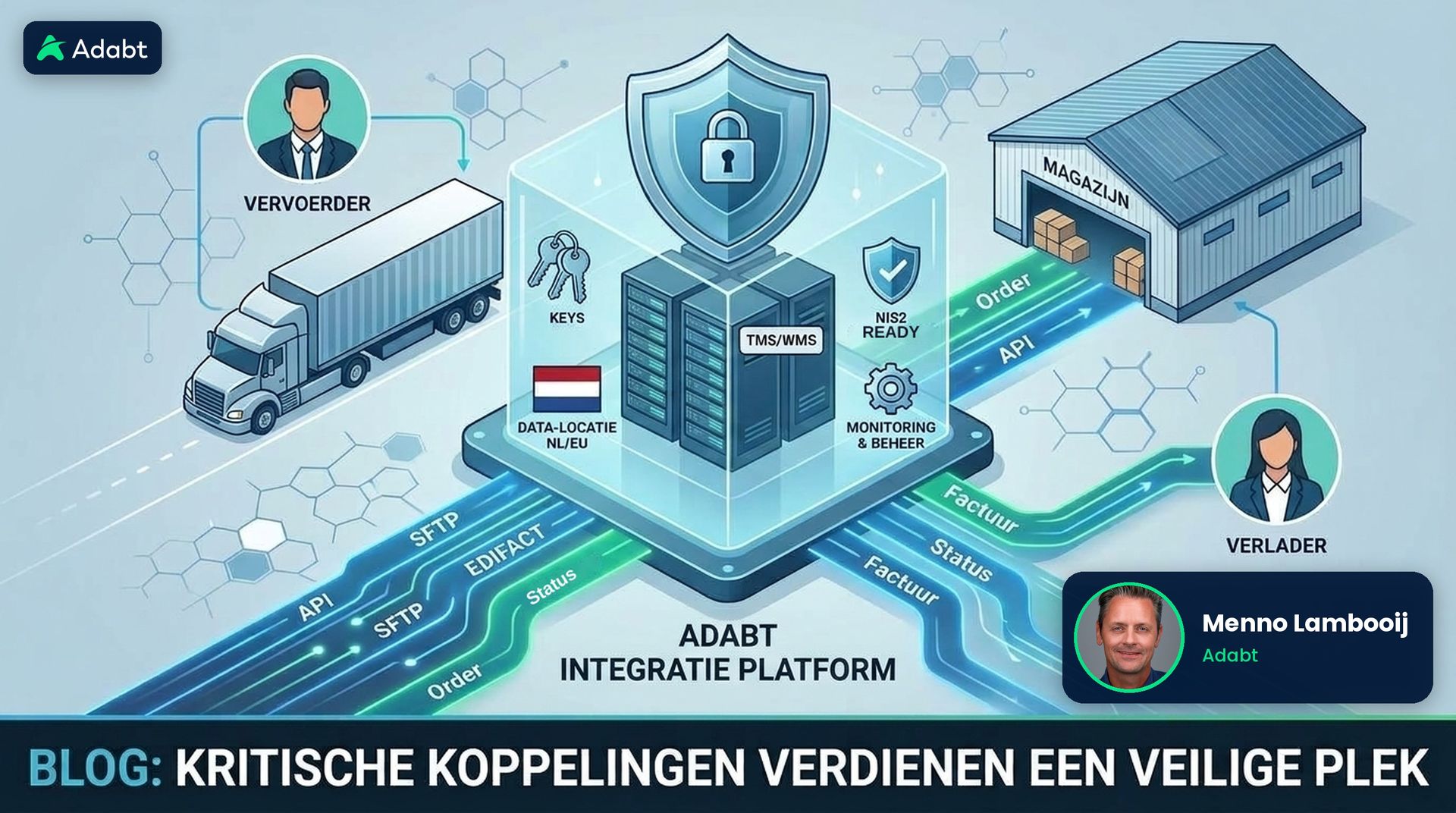
It has never been so easy to tie two systems together. An AI assistant writes a script in an afternoon that pulls orders from your mailbox and puts them into your TMS or WMS. Low-code platforms promise integrations in a few clicks. And more and more software suppliers offer their own 'integration module', free with the licence.
That is a gain. But it also raises a question that is asked too rarely in logistics: is the cheapest integration also the wisest? Especially when it comes to the integrations your operation runs on: orders from shippers, status updates to customers, invoicing, customs data, positions of your fleet.
In this blog I explain why we at Adabt believe critical integrations belong outside your core applications, and why they should run in a secure, managed environment.
Integrations do not belong in your TMS or WMS
A TMS or WMS is built to plan and execute transport and inventory. Not to talk to dozens of external parties, each with its own format, protocol and wish list. Anyone who builds integrations into the core application will run into trouble sooner or later.
- One leak, the whole house open. An integration is by definition a door to the outside. If that door sits in your TMS or WMS, a bug or a leaked key is directly connected to all your planning data, customer data and rates. A separate integration layer acts as an airlock: external parties only see what they need to see.
- Less dependent on one supplier. Integrations baked into your TMS or WMS do not move with you when you switch systems. If they sit outside it, you can replace the core application without having to reconnect thirty customers and partners.
- Updates without a chain reaction. A new version of your TMS or WMS should not break an integration with a shipper, and a changed message format from a customer should not bring your planning to a halt. A separate integration layer absorbs those changes.
- Overview and control. In one integration environment you see all data flows together: what comes in, what goes wrong and who has access. Spread across applications, scripts and mailboxes, that overview simply does not exist.
- Standards instead of custom work per party. With an integration layer you translate every external format into one language, for example the Open Trip Model (OTM) standard. Your core application then only needs to know one integration.
Where your integration runs matters
An integration that works is not yet a secure integration. The script on a planner's laptop, the free automation service with a password in its configuration, the AI tool that sends order confirmations to a server outside Europe: they all do what they are supposed to do. Until something goes wrong.
A secure environment for critical integrations meets at least these requirements:
- Data stays in Europe, preferably in the Netherlands. Orders contain names, addresses, phone numbers and sometimes sensitive cargo information. You want to know where that data is stored and under which jurisdiction.
- Access is restricted and personal. Multi-factor authentication, no shared accounts and no passwords in scripts. Who can access an integration is known and recorded.
- Everything is logged. In case of a disruption or a customer question, you want to be able to see which message arrived when, what was done with it and where it may have got stuck.
- Someone is paying attention. Monitoring and alerts make sure a faltering integration is noticed before your customer calls. And there is someone to fix it, even when the colleague who wrote the script is on holiday.
- Security is kept up to date. Software and servers receive security updates on time. An integration nobody has touched for three years is an open door.
On top of that, the rules are getting stricter. With NIS2, more and more transport and logistics companies fall under information security obligations, and these also apply to your chain partners and suppliers. Your shippers will ask you how you process their data. 'It runs in a script somewhere' is not an answer you want to give.
Cheap integration can turn out expensive
Building an integration is only a small part of the cost. Most of it comes in the years after: maintenance, changes, outages and the risk of something going wrong. That is exactly where quick solutions fall short.
| Quickly built yourself | Managed integration | |
|---|---|---|
| Building | Hours to days, low cost | A bit more time, fixed agreements |
| Knowledge | With one person or in an AI prompt | Documented and secured in a team |
| Outage | You notice when the customer calls | Alert and follow-up by support |
| Change at partner | Figure it out and build it again | Part of managed support |
| Security | Depends on who built it | Set up and maintained |
| Data location | Often unknown | Known: the Netherlands and Europe |
AI makes building faster, for us too. But AI does not take over responsibility. Anyone who has an integration generated without understanding what is in it, also does not know which data goes where. A day of downtime in order entry, a missed status update for a major shipper or a data breach quickly costs more than years of managed support.
How Adabt approaches it
At Adabt we build and manage integrations as a managed service. Your integrations do not run in your TMS or WMS, nor on a separate server in the office, but in our integration environment.
- Hosted in the Netherlands. Our integration platform, built on Lobster Data Platform, runs in a Dutch data centre. Our AI applications, such as AI Order Entry, run in Microsoft Azure in West Europe.
- Access under control. Multi-factor authentication is mandatory everywhere at Adabt, and we apply critical security updates within fourteen days.
- Monitoring and follow-up. We get alerted when a data flow falters and pick it up, with priority when your operation is at risk.
- Even when there is no API. With Adabt Gateway our cloud applications get secure access to a local database, without you having to open up your network.
- Based on standards. Wherever possible we integrate via OTM, so you are less dependent on a single system or supplier.
And we use AI ourselves too: AI Order Entry and DocMatch read orders and transport documents and put them into your TMS. The difference is not in the technology, but in where it runs and who is responsible for it.
Choose consciously
Not every integration needs to be a managed service. A one-off export or an internal report can be put together quickly. But for the integrations your customers, your planning and your revenue depend on, the question is not how cheap it can be. The question is what it costs when it goes wrong.
Curious how your integrations are doing right now? Contact us at support@adabt.com or call +31 76 2005 051. We are happy to take a look with you.