Integrations7 min
OTM, more than 5 years later: from promise to practice
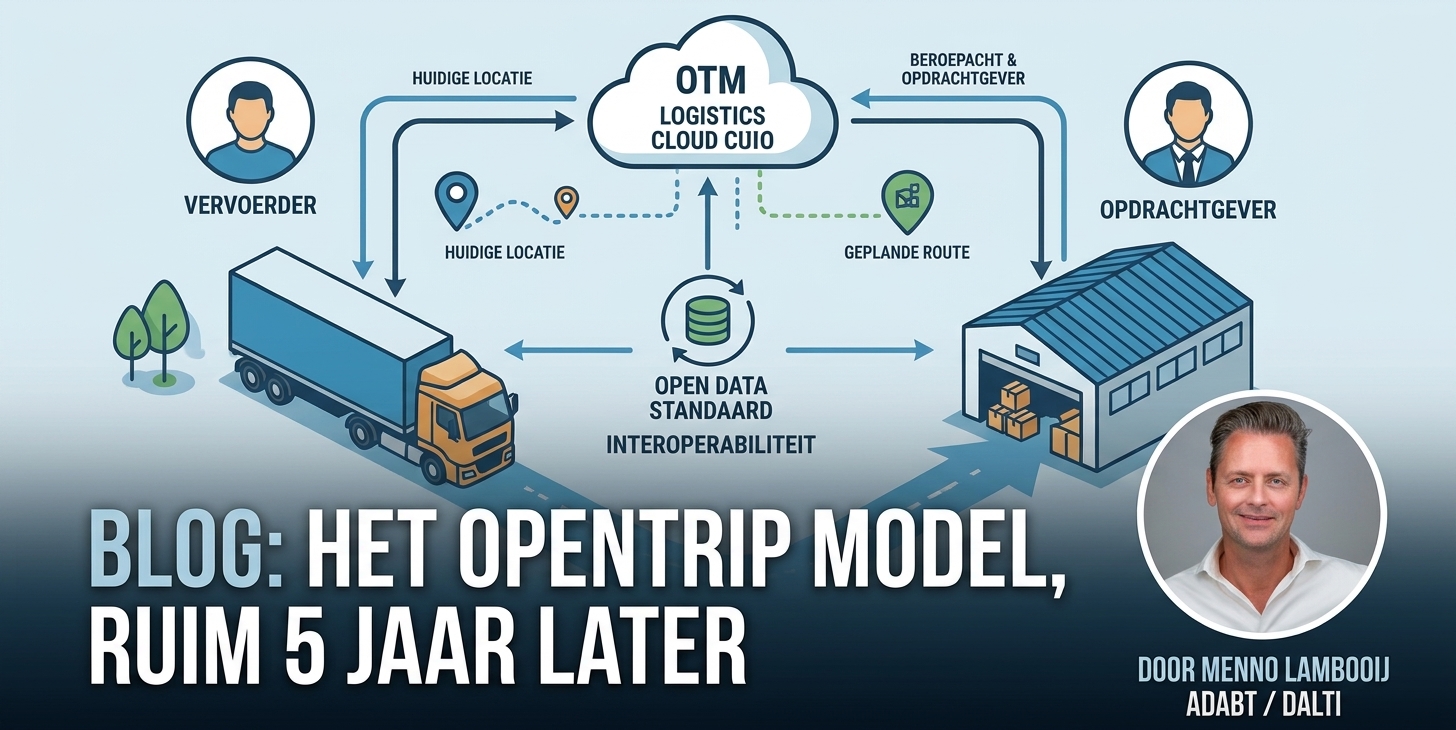
Back to December 2020
In December 2020 I wrote the blog OTM5, what can you do with it? (in Dutch). In it I described ten applications of the Open Trip Model: from sharing planning between shipper and carrier to real-time status updates, digital transport orders, CBS reporting, e-CMR and CO₂ footprint.
Back then, many of those applications were mainly a promise. The big question was whether OTM would grow into a real industry standard. More than five years later it is time to take stock. What has happened, where is OTM used in practice today, and why does it still matter?
What has happened since 2020
In five years OTM has grown from a promising model into a mature, widely supported standard. Three developments stand out.
The standard has evolved. We went from OTM 5.0 to version 5.8, released in March 2026. A lot was added along the way: emissions (5.1), contextEvents (5.4) and in the latest version multiple fuel types per vehicle, volume data and extended emission standards, among other things. Every step came from concrete questions from practice.
Governance has matured. OTM is managed by SUTC, completely in the open. Change requests and discussions run via GitHub; specifications and profiles can be found in Semantic Treehouse. There is also the annual OTM Knowledge Day, where users, suppliers and government meet. At the latest edition in December 2025, presenters included Simacan, PostNL, Heijmans, Cargonaut, Filogic, TANS, TNO, CBS and the Dutch Ministry of Infrastructure and Water Management (IenW).
From one big model to profiles. OTM has a broad scope, and that is a strength. But anyone connecting two systems wants to know which fields are really needed. That is why there are more and more profiles: agreed subsets for one specific application, such as the CBS survey or CO₂ reporting. That makes implementation a lot simpler.
I have been involved with OTM from the start, first through TLN and Topsector Logistiek. Today my work on digital industry standards runs through DALTI and Adabt. It is great to see how an idea from a handful of parties has grown into something the whole sector builds on.
Where OTM is used today
Of the ten applications from 2020, most are now simply practice. An overview:
| Application | 2020: possibility | 2026: practice |
|---|---|---|
| TMS integrations | Digital transport order in a standard format | TMS suppliers such as TANS, RGB+ and Filogic have integrated OTM |
| TMS and on-board computer | Standard communication between TMS and on-board computer | Standard TMS–FMS interface, including at Filogic, FleetGO and MobiCoach |
| CBS reporting | Automatic delivery of statistics | Since May 2025 officially via OTM, developed jointly by CBS and TLN |
| Municipal data | Sharing time windows and restrictions | NDW provides low- and zero-emission zones in OTM; IenW is working on a digital accessibility map |
| CO₂ footprint | Measuring and reporting emissions | A dedicated OTM profile for CO₂ reporting, developed by a consortium |
| Planning and status | Real-time updates between shipper and carrier | Widely used, including at Simacan and PostNL |
| e-CMR and eFTI | Digital consignment note | Alignment with the European eFTI regulation in progress |
OTM in the TMS. Perhaps the most important step is that TMS suppliers such as TANS, RGB+ and Filogic have integrated OTM into their applications. OTM is no longer a project of a few frontrunners. It is in the software carriers work with every day.
CBS survey without a questionnaire. Carriers can now submit the Statistics Netherlands (CBS) road transport survey via OTM, instead of via CBS-XML or an online questionnaire. Those who deliver fully automatically no longer have to fill in the questionnaire. TANS already supports this.
New sectors. OTM is also used outside classic road transport, for example in construction logistics (Heijmans) and air cargo (Cargonaut).
Five years of OTM at Adabt
For me personally, too, these have been five special years. I have been on the road with Adabt since 2021, and in that time we have built quite a few OTM integrations. That is where I see in practice what I could only describe in 2020.
- AI Order Entry. Orders that arrive by email or as a PDF are converted with AI into a structured transport order and delivered to the TMS via OTM. We do this for TALIS and Transplan, among others.
- Order and status integrations. Transport orders out, status updates back, between shippers, carriers and their systems.
- CBS reporting. Automatic submission of the road transport survey via OTM.
- Simacan Control Tower. Integrations for orders, trips and positions, giving shippers and carriers real-time insight into execution.
What strikes me: every new OTM connection goes faster than the last. We connect with TMS applications such as RGB+ and TANS that already speak OTM. So we do not have to build a separate format for each system. That is exactly the promise of a standard.
Why OTM still matters
The demand for good data exchange has only grown since 2020. Five reasons why OTM continues to play a key role.
- Regulation demands data. Zero-emission zones, CO₂ reporting and the European eFTI regulation all require reliable, digital transport data. With one shared language you do not need to build a new connection for every new requirement.
- Build once, reuse often. CBS says it itself: anyone with an OTM connection to CBS can use that investment for other purposes too. That applies to every OTM connection.
- Government and industry speak the same language. CBS, NDW, IenW, TNO and market parties use the same standard. That prevents every authority from imposing its own format.
- Open and transparent. Anyone can follow and contribute to its development. There is no dependency on a single supplier.
- AI makes standards more important, not less. AI helps turn unstructured information, such as an order in an email, into usable data. But that data has to go somewhere, in a form every system understands. That is what OTM provides.
In 2020 I wrote: OTM is the language of exchange, iSHARE governs who may see which data. That division still holds. OTM describes what is shared; trust frameworks such as iSHARE and the Basis Data Infrastructuur (BDI) govern with whom.
What can be improved, and what is coming
OTM is not there yet. The standard is mature, but adoption is not yet a given everywhere.
- Smaller carriers and suppliers. Large parties and the well-known TMS suppliers are on board. For smaller carriers and niche software the step is sometimes still big.
- Profiles over custom work. A broad standard invites individual interpretations. The more we work with agreed profiles, the less custom work each connection needs.
- European alignment. eFTI brings a European framework for digital freight information. Aligning OTM with it is an important theme for the coming years.
- Emissions. The CO₂ profile and the extended emission standards in version 5.8 lay a foundation. Demand for emissions data will only increase.
Has OTM become an industry standard?
In 2020 I wondered whether OTM had a chance to become the standard for logistics data exchange. Five years later my answer is: yes. OTM is in carriers' TMS software, is used by CBS, NDW and the ministry, and is developed further based on questions from practice.
You can follow developments continuously via Semantic Treehouse and the OTM GitHub environment. Specifications, discussions and progress are shared openly there. You can also submit a change request yourself.
My call: follow along, think along and join in. A standard is only as strong as the parties that use it. Want to know what an OTM connection can do for your organisation? Get in touch.